

- And What Rose From The Ashes of The Ariel Assault On Uncle Sam's World
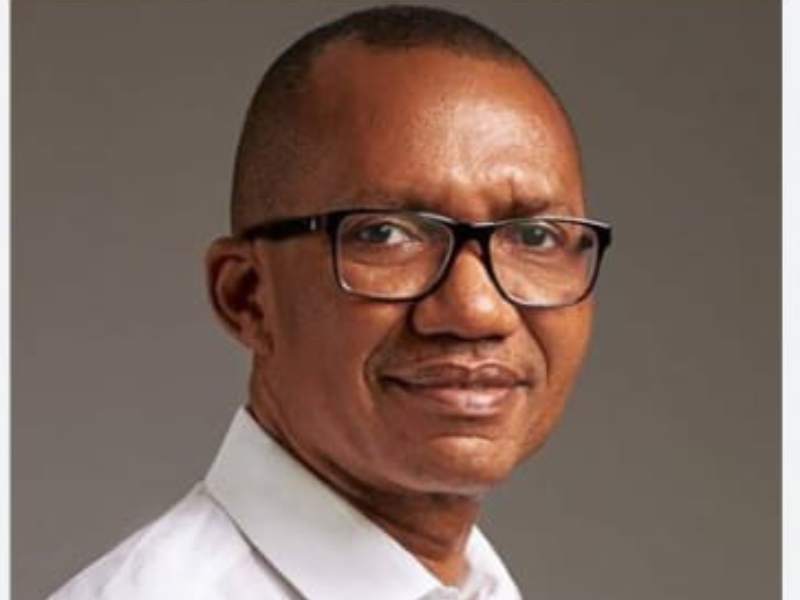
By Celestine Okafor (Editor-in-chief)
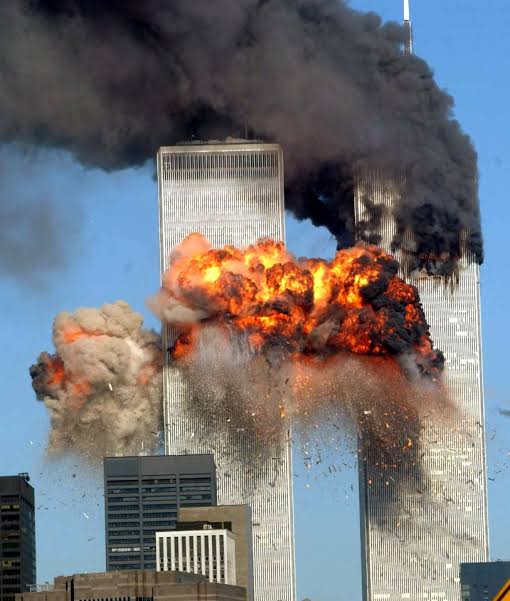
Dateline: Tuesday, September 11, 2001. At exactly 8:46 a.m, the world rose in terrifying shock to the ariel terror assault on the twin towers of the World Trade Center located in the heart of the bustling financial district of Borough area of lower Manhattan, in New York City, United States of America.
That ill-fated morning, bedlam, tears and agony ruled and reigned on the entire cities and states of America, otherwise referred to as 'Uncle Sam's' country. And within the precincts of the White House, the US Presidency, located on 1600 Pennsylvania Avenue in Washington DC, trepidation gripped ex-President George Bush jnr and his Oval shaped office officials. Even the dark, cloudy billowing smoke from the wreckage of the damaged towers could be palpably felt in Pentagon, the US Department of Defense on Arlington County, Virginia, and at the Congressional headquarters on Capitol Hill.
However, moments after the attack, the US federal security aparatchick frantically went to work. The Central Intelligence Agency (CIA), the Federal Bureau of Intelligence (FBI), the Pentagon Defence headquarters, and other security establishments of the America's Union of States, began to sniff around with precision. Who done it, as Americans are wont to ask? The al-Queda terrorists network led by the slain, thick-bearded Osama Bin Ladin, was primarily fingered!
A highly enraged President George Bush jnr, later arrived the scene of the terror onslaught for an on-spot presidential assessment of the damage. With a hand-held amplifier speaker on hand, Bush cursed volubly on the al-Queda terrorists, and threatened in high-pitched military voice and with a tone of finality: "We will get you"! The battle line was instantly drawn between America and the terrorists group.
Within weeks, and as the US state intelligence gathering peaks, the Republican government of America under President Bush jnr swiftly despatched the dreaded US Navy SEALs, a special trained counter-insurgency and terrorism forces that conducts covert, high-risk special operations missions across sea, air, and land, to comb with a fine tooth comb, the mountains and dangerous highlands of Afghanistan and other pro-terrorism countries, to fish out the culprits of the Trade Center attacks.
This US Special Force, the Navy SEALs, have operational potentials and military logistics to successfully invade almost impregnable terrains to hit state targets. Their training enables them to operate in extreme and diverse environments, including maritime oceans, rivers, and underwater; Arctic and cold weather; jungles and mountains; deserts and even urban areas.
As a matter of duty, the core mission of the American Navy SEALs used in routing the terrorists after the World Trade Center attacks, include a direction action of launching precision raids and ambushes against high-value military targets, terrorist cells, or enemy infrastructure. Their special reconnaissance operations include gathering vital intelligence on enemy forces and terrain from deep behind enemy lines or in hostile areas. The Navy SEALs Counter-terrorism engagements involved responding to global terrorist threats, neutralizing bomb-making networks, and disrupting enemy plots.
They carry out rescue operations too by locating and freeing captured people in dangerous or politically sensitive regions of the globe, and they involve in unconventional warfare and Defence operations like training allied foreign military forces and local resistance groups in counter-guerrilla and defense tactics. Their maritime operations include clearing underwater obstacles, conducting hydrographic reconnaissance before beach landings, and intercepting rogue vessels.
However, the US intensive and convulsive manhunt for the Al-queda terrorists that owned up to the attacks on the twin towers of World Trade Center in New York, paid off precisely ten years after the incident, in the early hours of Monday, May 2, 2011, when the American special force (the Navy SEALs) flew stealthily in an undercover nighttime operation through the airspace of Pakistan, into its capital city of Islamabad, and finally decimated their target - Osama bin laden, right inside a residence where he hid with members of his family. The entire operation on the ground took just about 38 to 45 minutes.
This US homicide expedition was undertaken by about 24 to 25 elite operators team from the American SEAL Team Six of the Naval Special Warfare Development Group. Their attack strategy involves two stealth Black Hawk helicopters that flew low from a base in Afghanistan across the border into Abbottabad, Pakistan, avoiding radar detection, where they killed the terror warlord, Osama Bin Ladin.
The Navy SEALs commandos, in the course of the raid, stormed the compound where Mr Bin Ladin was hiding. They reportedly engaged and killed Osama's couriers and one of his son in the lower levels of the compound during a firefight raid. The SEALs moved up to the third floor and entered Bin Ladin’s room, where he was shot and felled in volleys of hot bullets that ripped, wide open, his forehead and part of his skull.
In the aftermath of the raid operation, one helicopter used by the SEALs Special attack team, suffered a mechanical failure and was intentionally destroyed by the team. The operators gathered numerous hard drives and documents, flew back to Afghanistan with Osama Bin Ladin’s body, and later buried his remains at sea after confirming his identity through DNA testing. The death of Mr Ladin drew great ululation in America and most in anti-terrorism countries.
Today, the site of the 9/11 terrorist attack is referred to as "Ground Zero" in America. It currently houses the rebuilt World Trade Centre complex and the National September 11 Memorial and Museum.
However, twenty-five years after the attack incident, today, Friday, September 11, 2026, just a quarter-century has passed since two hijacked airliners tore into the World Trade Center's Twin Towers on that clear blue Tuesday morning. Yet, the lower Manhattan fell quiet again today at exactly the same time of the terror attack, at 8:46 a.m.
Families of the 2,977 people killed that day gathered at the National September 11 Memorial plaza, where the ceremony began at 8:30 a.m. and unfolded around seven separate moments of silence — six marking the strikes on the towers, the Pentagon and the crash of Flight 93, and, for the first time this year, a seventh honoring those who have since died of 9/11-related illness.
Every living former U.S. president attended the New York ceremony. On the roll call, is Bill Clinton, George W. Bush jnr, Barack Obama and Joe Biden, alongside Vice President J.D Vance and New York City Mayor, Zohran Mamdani, while President Donald Trump marked the morning at the Pentagon with Secretary of War, Pete Hegseth. Tonight, the Tribute in Light will once again send two beams of blue-white light skyward from Lower Manhattan. This year's 9/11 memorial event was broadcast live nationally for the first time in partnership with the 9/11 Memorial and Museum.
It happens that on the morning that changed everything at 8:46 a.m. that Tuesday, September 11, 2001, American Airlines Flight 11 struck the North Tower of the World Trade Center. Seventeen minutes later, United Airlines Flight 175 hit the South Tower. Within two hours, both 110-story towers had collapsed, killing thousands trapped inside, including hundreds of first responders who had rushed in to save them.
A third hijacked plane, however, struck the Pentagon; a fourth, United Flight 93, crashed into a Pennsylvania field after passengers fought back against their hijackers. In total, 2,977 people were killed in the deadliest terrorist attack ever carried out on American soil, orchestrated by the al-Qaeda network under Osama bin Laden.
The attacks did not simply kill nearly 3,000 people; they reordered American foreign policy, domestic security law and the texture of everyday public life, from airport screening to the surveillance architecture that now underpins modern governments. A generation of Americans has now grown up never having known a pre-9/11 world.
The 16-acre site where the Twin Towers once stood, looks nothing like it did in 2001, and nothing like the towers themselves, either. Planners decided early on against rebuilding identical replicas. And today, five new structures occupy or surround the footprint now referred to as 'Ground Zero's. One World Trade Center, the 1,776-foot glass tower designed by David Childs, has stood as the site's centerpiece since 2014; 7 World Trade Center, 3 World Trade Center and 4 World Trade Center are complete and occupied. The last piece of the rebuild, 2 World Trade Center, officially restarted construction in 2026 after more than a decade of delays.
That final tower's path to groundbreaking took longer than any other on the site. Port Authority leaders, New York City's mayor and executives from American Express gathered on the site in July 2026 for a groundbreaking ceremony on 2 World Trade Center, ending a decade of stalled design changes and failed tenant searches. British firm Foster Partners, who was originally hired to design the tower, was later replaced by the Bjarke Ingels Group, and then returned after that stepped, terraced design drew mixed reviews. The current plan is a rectangular glass tower threaded with open-air terraces and landscaped corner gardens.
The building is being designed as fully electric, with rainwater collection systems built in to help cool the tower and irrigate the surrounding public green space. American Express announced in February 2026 that it would become the tower's sole owner and occupant, finally resolving the anchor-tenant problem that had stalled the project for years. Once it opens, expectedly around 2031, the commercial rebuild of the 16-acre site will essentially be complete, leaving only a planned 5 World Trade Center as an open question.
Where the towers themselves stood, twin reflecting pools now mark their footprints, ringed by bronze parapets bearing the names of the dead — the National September 11 Memorial, which opened on the tenth anniversary in 2011. The adjoining museum, the Oculus transit hub, and the Perelman Performing Arts Center, which opened in 2023, complete a district that is as much cultural and civic space as commercial real estate.
Not everyone considers the rebuild a triumph: some New Yorkers who watched the process unfold for a quarter-century, argue that the new towers are architecturally forgettable and that the site feels sanitized compared with what was lost, while others counter that the presence of a rebuilt skyline — and a mayor's race won by a Muslim candidate on the anniversary's very eve of commemorations — is itself proof the attackers failed to break the city.
Today, America is like a nation still divided over the meaning of that day. Twenty-five years have not settled what 9/11 means to the country it happened to. Americans gathering to remember the attacks today, Friday September 11, 2026, remain divided about their legacy, a divide that spilled into open political dispute even around today's ceremonies, including criticism of Mayor Mamdani's attendance over his past association with a commentator who once said America "deserved" the attacks, a remark he later disavowed and called "objectionable and reprehensible."
That argument sits alongside a quieter, more damning one: New York City, this week, released previously undisclosed records showing that officials in 2001 knew that air quality around Ground Zero was unsafe, even as they told the public otherwise. This has reopened old wounds for the tens of thousands of survivors and responders who have since died or fallen ill from exposure to the toxic dust cloud. That reckoning is part of why organizers added a seventh moment of silence this year — an acknowledgment that the 9/11 story has never simply been about a single morning, but about a toll that has continued to accumulate for a quarter-century afterward.
Alongside the mourning, this year's commemorations of the 9/11 incident, have leaned into a message of transformation through service. A new exhibition at the museum, "In Their Honor: 25 Years of 9/11-Inspired Service," profiles people who devoted their lives to public service after living through the trauma of that day, with museum director, Elizabeth Hillman, framing the capacity to answer catastrophic loss with compassion and courage as the era's most powerful lesson.
For the 9/11 incident, the attacks launched what became known as the War on Terror: the invasion of Afghanistan within weeks, the 2003 invasion of Iraq, a vast expansion of domestic surveillance, the creation of the Department of Homeland Security, and two decades of continuous American military engagement abroad. Osama bin Laden was killed by U.S. special forces, the Navy SEALs, in Pakistan in 2011; his successor, Ayman al-Zawahiri, was also killed in a 2022 drone strike in Kabul.
Al-Qaeda itself, though, was never destroyed. The organization today looks nothing like it did in 2001. Its central leadership has been decimated, its founder and his successor are both dead, and its operational center of gravity has shifted from Afghanistan and Pakistan toward Africa. What sustains it now is a franchise model, letting regional branches wage local wars under a shared ideological banner, while what remains of central command offers strategic guidance from a distance — reportedly including a current leader, Sayf al-Adl, who intelligence assessments say is based in Iran.
Current U.S. intelligence estimates put al-Qaeda's global membership at roughly 15,000 to 28,000, alongside 12,000 to 18,000 fighters for ISIS, with Africa now the focal point of the global jihadist movement.
Analysts describe today's threat picture as more diffuse and harder to predict than the one America faced in the attack's immediate aftermath.
Unlike the period right after 9/11, there is no longer a single paramount threat; instead the U.S. faces a mix of formal groups, loose networks and lone actors, with al-Qaeda affiliates and Islamic State provinces posing the greatest danger abroad, many of them growing stronger, particularly in Africa — even without current intent to strike the American homeland. Inside the United States itself, the more immediate danger now comes largely from lone actors and loose networks driven by niche or blended ideologies that resist traditional counterterrorism analysis.
What, then, has America and the world actually learned? A few threads run through 25 years of hindsight:
- Resilience outlasts destruction, but doesn't erase cost.
- The rebuilt skyline, the memorial, the return of commerce and daily life to Lower Manhattan all stand as evidence that catastrophic terrorism did not break New York's civic and economic life. But the cost was never confined to that morning — thousands more have since died of exposure-related illness, a toll the city is only now being forced to fully acknowledge
- Decentralized threats are harder to defeat than the enemies who attacked in 2001.
- Al-Qaeda's core leadership was hunted down over two decades, yet the ideology metastasized into a looser, more resilient network of regional affiliates that current intelligence assessments say continues to grow in parts of Africa and the Middle East.
- Security and liberty remain in permanent tension.
- The surveillance state, airport security regime, and homeland security bureaucracy built after 2001 became permanent features of American life — a trade-off whose value is still debated, but whose scope has never meaningfully receded.
- Unity is fragile and contested, not automatic.
- The instinctive national solidarity of September 2001 gave way, over 25 years, to sharp disagreement over what the attacks should mean — for immigration policy, for foreign wars, for how public officials should even be permitted to commemorate the day.
- Institutional honesty lags institutional memory.
- It took a quarter-century for the full record on Ground Zero's air quality to surface publicly, a reminder that official narratives formed in a crisis's immediate aftermath often require years of pressure before they're corrected.
This Friday, September 11, 2026 night, as the Tribute in Light rises once more over a rebuilt Lower Manhattan skyline that still, after 25 years, remains a work in progress. The anniversary lands less as a closed chapter than as an unfinished argument — about grief, architecture, security, and what the country owes both the dead and the living who carry what happened next. NNL.