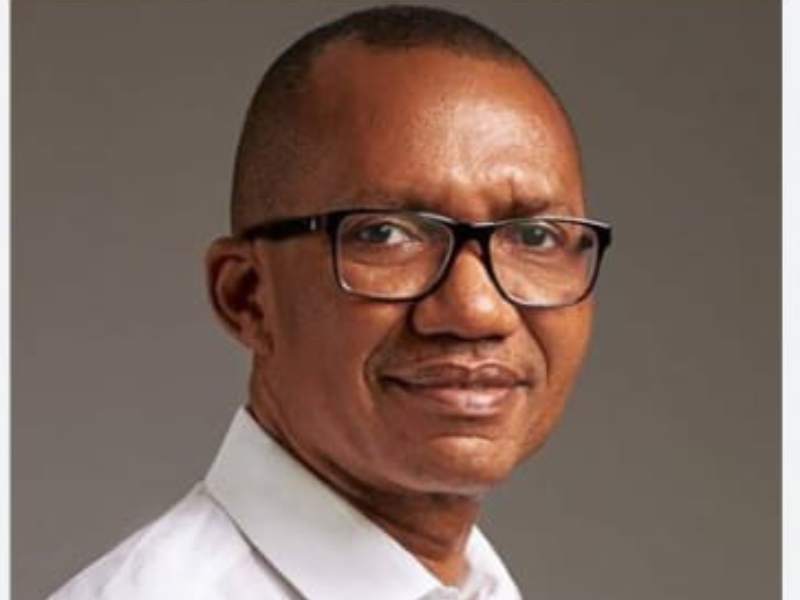



By Hassan Gimba
The first instalment of this article was published last week. Originally published in December 2021, I feel compelled to republish it now because its concerns about the rule of law, insecurity, and the fear ordinary Nigerians experience remain relevant today. The article serves as a timely reminder of the urgent need to protect citizens, uphold justice, and restore peace and security across the country.
This is the second part of our treatise on the rule of law that started last week. The rule of law is about the creation of laws and their enforcement so that no one - including the most highly placed citizen - is above the law.
When you look at how organised countries control their affairs, you see that the weakest and the strongest face the same law and receive the same justice when they are caught for a misdemeanour.
In an ideal country, those at the helm of affairs are always mindful of doing the right thing. But our country used to be like that. What went wrong along the way that made things deteriorate to the point where state actors assume superiority over the state itself? Civil servants and even political appointees no longer remind, guide, or nudge their bosses to uphold the best standards.
For instance, a source said he watched an NTA Kaduna interview session with the late General Hassan Usman Katsina in July 1987. General Katsina was the governor of Northern Nigeria before General Yakubu Gowon created 12 states. The interviewer asked General Hassan how he compares governors today with those of his time (1966). This was his reply…
“I am going to give you an example, and you can figure out the answer yourself. When I was the Governor of Northern Nigeria, Dr Abubakar Imam was the General Manager of Kaduna Capital Territory. In that year, we decided to allocate plots for the present GRA in Kaduna. I applied. KAT conducted the exercise. They allocated all the plots, but I was not given one. I did not care to find out why. After the exercise, Dr Abubakar Imam came to my office with my application. He told me they had finished the exercise. He also said he had seen my application. However, he said they did not consider me qualified because I am the governor. He said that, as the leader, I should be more interested in my subjects’ interests than my own. How sure was I that all citizens who wanted the plots got allocated before I applied? He said he came with my application to tear it before me so that it would not come to me as a rumour, and he tore the piece of paper.”
There is also a story written by a retired 75-year-old former Confidential Secretary to Audu Howeidy, the Secretary to the Government when the late Police Commissioner, Audu Bako, was the governor of Kano State, in which a Permanent Secretary queried the governor.
Alhaji Sani Danbatta, Permanent Secretary of the Ministry of Finance, queried Audu Bako for receiving 25 pounds monthly as an allowance and 125 pounds as an entertainment allowance. His imprest was then 10,000 pounds monthly. The Permanent Secretary questioned why he allocated allowances to himself that were not provided in the General Order (public service rules). Danbatta further asked the governor to refund the illegal allowances he collected over the past eight months to the treasury or be surcharged by deduction at source.
Audu Bako summoned all the Permanent Secretaries and demanded an explanation from Danbatta, saying he did not understand the query. The perm sec said, “I have no explanation to give you, I passed the query through Alhaji Audi Howeidy, the Secretary to the Government, let Howeidy as an administrator say he did not understand the content, then I will explain.”
The Secretary to the Government then presented a memo to the state executive council seeking approval to regularise the two allowances for the governor, and approval was accordingly granted.
Yet again, the perm sec wrote a memo to Howeidy informing him that the new allowances to the governor should be taxed. The SSG referred the matter to the Kano State Commissioner for Revenue, Mr OB Wise (a Briton), who said that our existing laws have no tax on allowances.
In those days, civil servants could confront political leaders without fear or favour to correct them whenever they violated laid-down procedures, rules, and regulations, unlike what is obtainable nowadays. The rule of law was observed to the letter.
Before General Katsina and Compol Bako, the example was Sir Ahmadu Bello, the Sardauna of Sokoto and Premier of the Northern Region. The regional government constructed airstrips for the Premier's use in most provinces. They were in Mubi, Jalingo, Wukari, Sokoto, Gusau, Minna, Azare, Gombe, Bauchi, Idah, and some other places.
The Premier had three small Cessna aircraft in his fleet, supervised by an Assistant District Officer (ADO) in his office, Alhaji Suleiman Gurin, a former teacher from Adamawa Province.
At one point, Sir Ahmadu Bello flew one of the aircraft to Sokoto on a private visit. When he returned to Kaduna, the region's administrative headquarters, Alhaji Suleiman Gurin sent him a bill for his flight to Sokoto!
To him, since it was a private visit, the Premier should refund it to the Government’s treasury. However, Sir Ahmadu Bello, though amused at the request, made the payment. He was so proud of his ADO for reminding him that everyone who served was subject to the state and to the laws made to govern that state.
But if these scenarios were about official responsibilities, they were prim and proper in how they conducted their social responsibilities as well.
The late Alhaji Alin Kotoko narrates a story (I think) about a Maiduguri-based contractor who benefited from the late Sardauna’s North First policy (empowering the region’s local business people). The narrator said the regional Ministry of Education gave them a contract, and they made a decent profit from it.
He and a colleague put a certain percentage of their profit in a paper envelope and went to the house of the ministry’s minister, Alhaji Isa Kaita, Wazirin Katsina. They were ushered into his sitting room, where he was sitting. They thanked him and had some brief discussions, but none of them could present the envelope to him. So, they got up to go but left the envelope there (a diplomatic way of presenting gifts to big men) by his side.
According to the narration, they were about to get into their car and drive off when he came out hurriedly and told them they had forgotten the envelope. Then one of them gathered enough courage and told him, “Sir, we made a good profit, and we brought you this token as appreciation”.
He told them what they would never forget. Calmly, he told them, “No, the Premier intended to empower you, people. I am his representative. If I want money, then I have to resign and start a business… it is your money; take it.”
With such exemplary behaviour and attitude, leaders were positive role models. By subjecting themselves to the rule of law and agreeing to be guided by those who know, they made the system work. Because they did not abuse the system because of their powers, their children too were not unduly favoured.
No parent then would harass a teacher because he had punished his ward, or pay for his child to get a good grade in an examination or be made a prefect in their schools.
How have our opposite actions and disregard for the rule of law impacted our society and brought us to our current sad state? We shall also look at that subsequently.
...Hassan Gimba, ANIPR, is the Publisher and CEO of Neptune Prime. NNL.